The 2026 U.S. Midterm Elections: What Is at Stake?
Heading into the midterm elections, Republicans control both chambers of Congress. Of the 435 seats in the House of Representatives, Republicans hold 218 against 214 for the Democrats. One independent representative caucuses with the Republicans, while two seats are vacant. In the Senate, Republicans hold 53 of the 100 seats. The 47 others are held by Democrats and two independent senators who caucus with them.
The current political environment favours the Democrats. High inflation, rising gasoline and food prices, an unpopular war with Iran, the President’s low
approval ratings and the Democrats' roughly seven-to eight-point lead in the generic congressional ballot all point to Democratic gains in the midterms.
This report examines what the two most likely outcomes—Republicans losing control of one or both chambers—would mean for the President’s
legislative agenda, including trade policy.
The party in power almost always loses seats
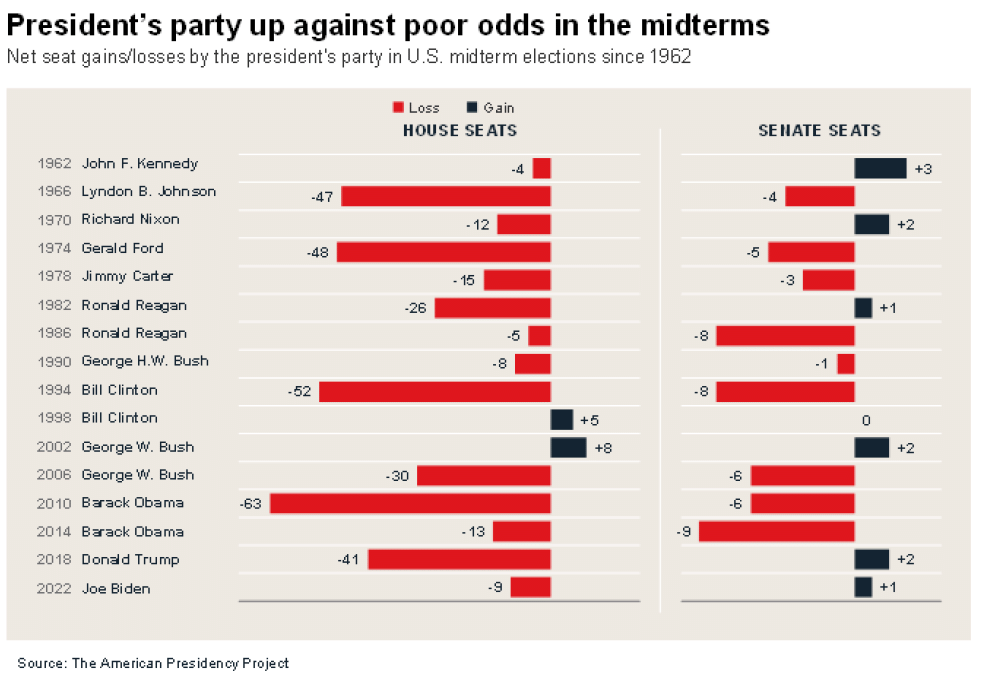
The president’s party almost always loses ground in midterm House elections. It has done so in 14 of the 16 midterm elections held since 1962.
The president’s party has fared somewhat better in the Senate, losing seats in nine of those elections. Historically, voters who oppose the sitting president have been more motivated to vote.
There have been only two exceptions to this pattern in the House of Representatives during the postwar era. Democrats gained five House seats under Bill Clinton in 1998, while Republicans gained eight under George W. Bush in 2002. The 1998 result reflected, in part, a backlash against the Republican-led impeachment effort against Clinton. In 2002, Republicans benefited from the rally-round-the-flag effect following 9/11.
Scenario 1: Democrats take the House, Republicans retain the Senate
▪ Divided control would make it much harder to pass major spending bills and other legislative initiatives
without bipartisan support.
▪ Barring a crisis, bipartisan agreements would probably be limited to essential measures, such as keeping the government operating and raising
the debt ceiling. For example, Democrats could support a government-funding bill in exchange for additional resources for Medicaid
and other social programs.
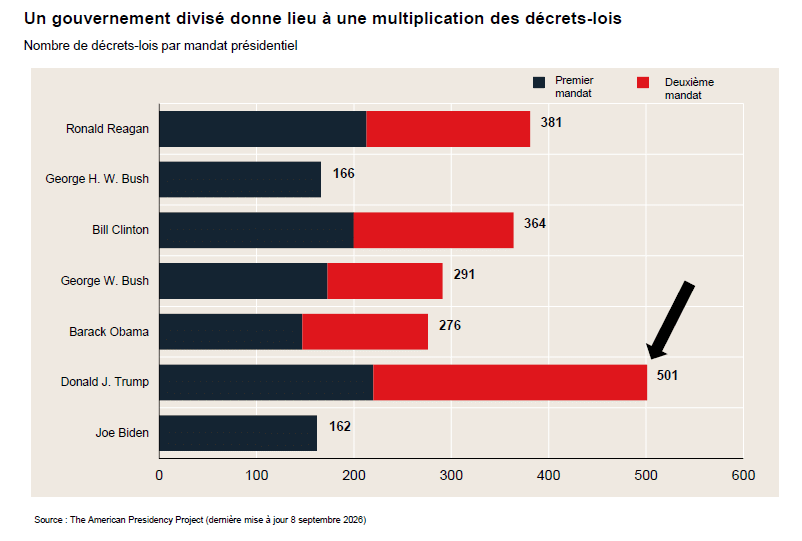
▪ President Trump would continue to pursue parts of his agenda through executive orders and regulatory actions. However, these measures remain
subject to legal challenges. Furthermore, a future president could revoke these orders without congressional approval.
▪ Control of the House would give Democrats control over committees and would thus allow them to launch new
investigations into President Trump
and his administration.
▪ Republican control of the Senate would still be a partial victory for Trump. It would allow the party to continue confirming
judges and department
heads. It would also grant Trump bragging rights that he beat the odds by retaining the majority.
▪ U.S. Treasury prices could receive modest support because a divided government would reduce the likelihood of significant additional deficit financed spending.
However, tighter fiscal policy could weigh on economic growth, and disputes over government funding
or the debt ceiling could stoke short-term market volatility.
Scenario 2: Democrats take the House and Senate
▪ Democratic control of both chambers would represent a major political setback for the Trump administration.
▪ The Democrats would control whether the White House nominees for judicial, senior
administrative and regulatory agency positions get Senate approval.
▪ Democratic committees in both chambers could also expand their investigations into President Trump and his administration.
This could include
initiating impeachment proceedings. The House could impeach the president by a simple majority,
but removal from office would require a twothirds
majority in the Senate—an outcome that remains highly unlikely.
▪ Although the Democrats would control which bills are introduced, most major legislation would require 60 votes in the Senate to overcome a filibuster.
And even if this hurdle were overcome, a bill would still require the support
of two-thirds of both chambers to override a presidential veto.
▪ Losing control of both chambers of Congress could weaken President Trump’s position within
the Republican Party, particularly if Republicans
blame him for their electoral losses.
▪ The President could still pursue parts of his agenda through executive action, particularly
regarding trade and foreign policy.
A few areas remain where bipartisan cooperation is possible
On the trade front, adopting a tougher stance on China is one of the few areas of bipartisan agreement. Several major bills to strengthen U.S. competitiveness vis-à-vis China have received bipartisan backing. The 2022 CHIPS and Science Act, for example, provided nearly $53 billion to support U.S. semiconductor manufacturing and research. It passed the Senate by 64 votes to 33 and the House by 243 votes to 187.
What could the midterms mean for Canada?
Because much of President Trump’s trade agenda has been conducted by way of executive authority, losing control of both chambers would not necessarily prevent him from imposing additional tariffs or other trade restrictions. Democrats could pass legislation to constrain these actions, but overriding a presidential veto would still require two-thirds support in each chamber.
However, a severe Republican defeat, combined with continued inflation, elevated bond yields, dissatisfaction among Trump supporters and opposition to the war in Iran, could increase pressure on the White House to reach a trade agreement with Canada. That pressure would be further reinforced by strong public opposition to the current level of trade tensions with Canada, which is the largest export market for 27 U.S. states.
Conclusion
In this era of intense partisanship, many of the most significant bills enacted under Presidents Trump and Biden passed largely along party lines. Democratic control of either chamber of Congress would therefore sharply constrain the Trump administration’s legislative agenda.
Bipartisan agreements would likely focus on essential measures such as government funding and the debt ceiling, responses to national emergencies, and shared priorities, such as competing with China. Consequently, President Trump would rely more heavily on executive authority, particularly where trade and foreign policy are concerned.
Finally, looking beyond the midterms, policy uncertainty is set to rise as attention turns to the priorities of the next presidential administration. Key questions will include the extent to which Washington's more inward-looking approach to trade policy will endure; how the next administration will reconcile its campaign promises with high public debt and borrowing costs; what direction AI regulation and energy policy will take; and how it will
manage the geopolitical, supply chain, and energy market consequences of the conflicts in Iran and Ukraine.
Article written by Angelo Katsoras, Geopolitical Analyst at National Bank of Canada.